




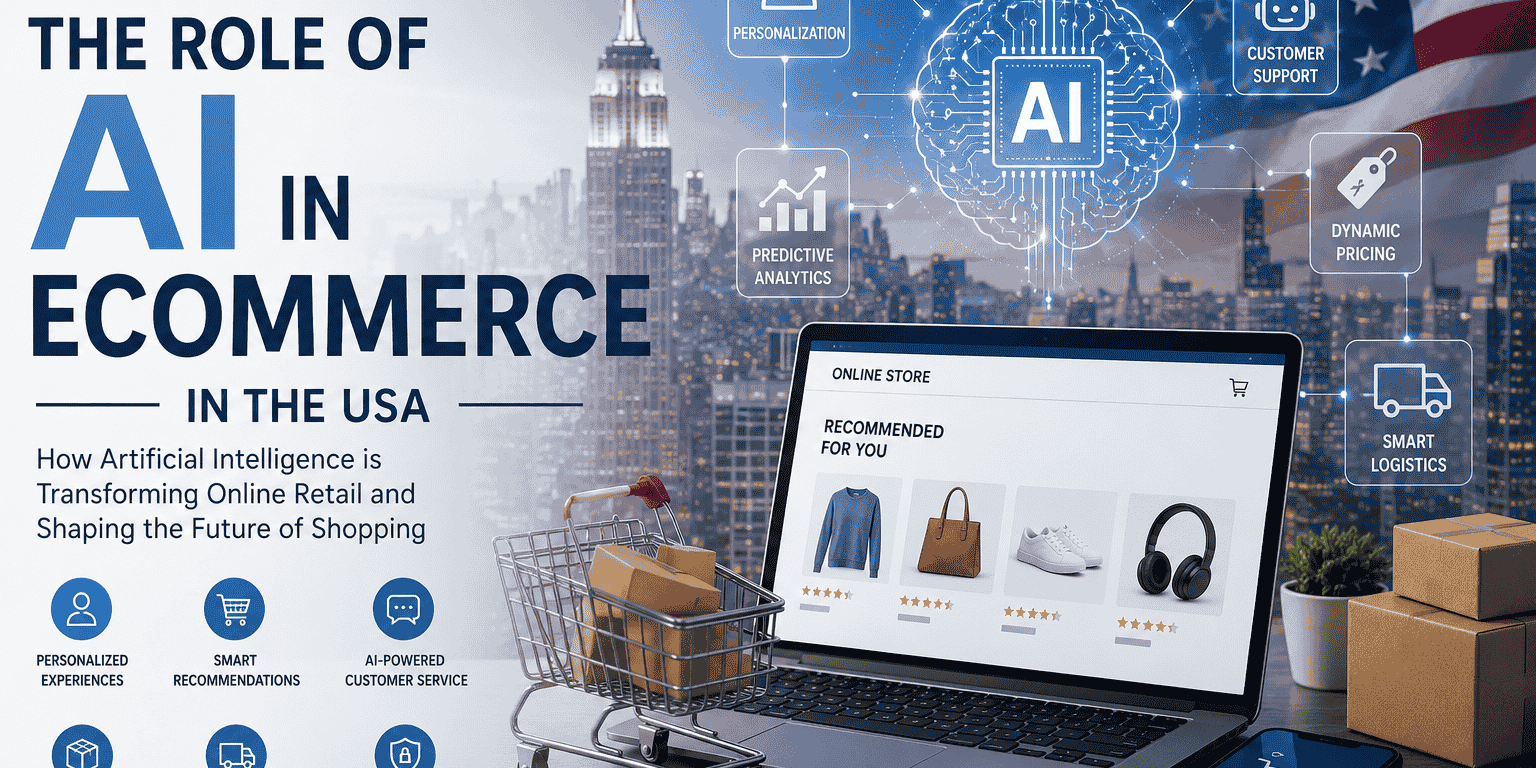
Artificial Intelligence (AI) is no longer a futuristic concept it has become a critical business tool that is reshaping the eCommerce industry across the United States. From personalized shopping experiences and intelligent inventory management to automated customer service and predictive analytics, AI is helping online retailers operate more efficiently while delivering superior customer experiences.
As the U.S. eCommerce market continues to grow and consumer expectations evolve, businesses that embrace AI-driven solutions are gaining a significant competitive advantage. The integration of AI into eCommerce is not simply about automation; it is about creating smarter, faster, and more customer-centric businesses.
The Growth of AI in U.S. eCommerce
The United States is home to some of the world’s largest eCommerce companies, many of which have invested heavily in artificial intelligence. Retail giants, direct-to-consumer brands, and online marketplaces are leveraging AI to optimize operations, reduce costs, and increase revenue.
Today’s consumers expect personalized recommendations, fast deliveries, responsive customer support, and seamless online experiences. Meeting these expectations at scale would be nearly impossible without AI-powered technologies.
Personalized Customer Experiences
One of the most significant applications of AI in eCommerce is personalization.
AI algorithms analyze customer behavior, browsing history, purchase patterns, and preferences to deliver customized shopping experiences. When customers receive product recommendations that align with their interests, they are more likely to engage and make purchases.
Benefits of AI-powered personalization include:
- Increased conversion rates
- Higher average order values
- Improved customer satisfaction
- Greater customer retention
- Enhanced brand loyalty
Modern consumers no longer want generic shopping experiences. They expect brands to understand their needs and provide relevant recommendations instantly.
Intelligent Product Recommendations
AI-powered recommendation engines have become a cornerstone of successful online retail operations.
By analyzing millions of data points, AI can identify purchasing patterns and suggest products customers are likely to buy. These recommendations appear on product pages, shopping carts, emails, and advertisements.
Effective recommendation systems help businesses:
- Increase cross-selling opportunities
- Boost upselling performance
- Improve customer engagement
- Generate additional revenue
For many U.S. eCommerce businesses, product recommendations account for a substantial percentage of total online sales.
AI-Powered Customer Service
Customer service is another area where AI is delivering remarkable results.
AI chatbots and virtual assistants can handle routine inquiries 24 hours a day, seven days a week. They can answer questions about orders, shipping, returns, inventory availability, and product information without human intervention.
Advantages include:
- Faster response times
- Reduced support costs
- Improved customer satisfaction
- Round-the-clock availability
- Scalable support during peak seasons
While human representatives remain essential for complex issues, AI significantly improves operational efficiency and customer experience.
Inventory Management and Demand Forecasting
Managing inventory effectively is one of the biggest challenges in eCommerce.
AI helps businesses forecast demand by analyzing historical sales data, seasonal trends, market conditions, customer behavior, and external factors. This enables retailers to maintain optimal inventory levels while minimizing stockouts and overstock situations.
Benefits include:
- Improved inventory accuracy
- Reduced carrying costs
- Better cash flow management
- Enhanced order fulfillment
- Increased profitability
For businesses selling across multiple channels, AI-driven inventory management has become increasingly important.
Dynamic Pricing Optimization
Price competitiveness plays a major role in online retail success.
AI systems can monitor competitor pricing, market demand, inventory levels, and customer behavior in real time. Based on these insights, pricing can be adjusted automatically to maximize sales and profitability.
Dynamic pricing allows businesses to:
- Remain competitive
- Increase profit margins
- Respond quickly to market changes
- Optimize promotional campaigns
- Improve revenue management
This capability is particularly valuable in highly competitive marketplaces where pricing changes frequently.
Fraud Detection and Cybersecurity
As online transactions increase, so does the risk of fraud.
AI-powered fraud detection systems analyze transaction patterns and identify unusual activities in real time. These systems can detect suspicious behavior that may indicate payment fraud, account takeovers, or identity theft.
Key benefits include:
- Reduced financial losses
- Improved customer trust
- Enhanced payment security
- Faster fraud prevention
- Better compliance management
Strong security measures are essential for maintaining customer confidence in digital commerce.
Supply Chain and Logistics Optimization
AI is also transforming supply chain management and logistics throughout the United States.
Advanced algorithms can optimize warehouse operations, route planning, shipment tracking, and delivery schedules. This helps businesses improve fulfillment speed while reducing operational costs.
AI-driven logistics can provide:
- Faster order processing
- Reduced transportation costs
- Improved warehouse efficiency
- Better inventory visibility
- Enhanced customer satisfaction
As same-day and next-day delivery become standard expectations, AI is playing a crucial role in meeting these demands.
Predictive Analytics for Business Growth
One of AI’s most powerful capabilities is predictive analytics.
By analyzing large datasets, AI can forecast future trends, customer behavior, product demand, and market opportunities. Business leaders can use these insights to make informed decisions and develop effective growth strategies.
Predictive analytics supports:
- Strategic planning
- Marketing optimization
- Product development
- Customer retention initiatives
- Revenue forecasting
Organizations that leverage predictive intelligence are often better positioned to adapt to changing market conditions.
The Future of AI in U.S. eCommerce
The future of eCommerce will be increasingly driven by artificial intelligence.
Emerging technologies such as generative AI, visual search, voice commerce, autonomous fulfillment systems, and advanced personalization engines will continue to transform how businesses operate and how consumers shop online.
Companies that invest in AI today are laying the foundation for long-term success in an increasingly competitive digital marketplace.
Conclusion
Artificial Intelligence is revolutionizing every aspect of the U.S. eCommerce industry. From personalized customer experiences and intelligent marketing to inventory management and logistics optimization, AI is helping businesses become more efficient, profitable, and customer-focused.
As technology continues to evolve, AI will become an even more important driver of innovation and growth. Businesses that embrace AI strategically will be better equipped to meet customer expectations, improve operational performance, and achieve sustainable success in the rapidly changing world of eCommerce.
The future of eCommerce is not just digital it is intelligent.